JIT bitmap text rendering for microcontrollers
Raph Levien, November 7, 2026
I've been working on vic-2350, a re-envisioning of an 80s home computer on an RP2350 microcontroller board. Of course, such a project needs text rendering. Though bitmap fonts are now out of favor, I chose them both for efficiency and because, at low resolutions, I prefer the aesthetic of a crisp, intentionally designed bitmap font over the blurry mush of antialiased font rendering. They still have a niche, if a narrow one.
I also wanted proportional spacing and kerning, again because I love the aesthetic of early Macintosh and its predecessors. Most text rendering in RP2350 projects is based on a fixed character cell, as achieving good performance is tricky.
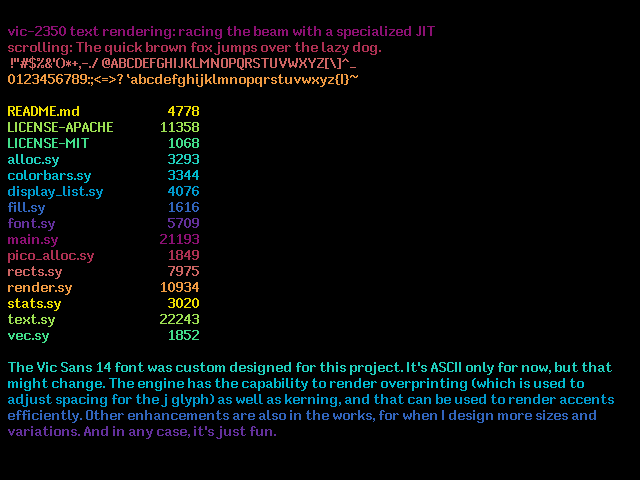
This blog post presents a technique for extremely fast rendering of bitmap text on microcontrollers such as the RP2350. I've implemented it as part of my race-the-beam renderer, but the same technique would work when writing into a framebuffer as well. The core idea is a JIT to generate highly optimized code on the fly for rendering a string.
Racing the beam
Around the mid-80s, a split was happening in the way computers displayed text. The established technique was a fixed cell size, and hardware that looked up characters in a font ROM on the fly as the image was scanned out to the monitor. The advantage was very fast update and responsiveness with limited hardware. A lot of terminals worked this way, as did home computers. The downside was the lack of flexibility. In particular, only monospace fonts were supported.
The newer technique was a bitmap framebuffer, as pioneered on a line of computers originating with the Xerox Alto, continuing through the Apple Lisa, and finally becoming popular with the Macintosh. The framebuffer was vastly more flexible, but required a lot more computing power to keep updated. In the early 80s, you would generally watch text progressively render. I should also mention, graphics modes were generally available on home computers, but they were typically lower resolution than text mode and a 1MHz 6502 (or similar) was just not powerful enough, so serious text-based programs like word processors and spreadsheets used text mode.
Fast forward to the RP2350. It is capable of DVI video out with the help of the HSTX peripheral, but it is still entirely up to software to fill the video buffer. Some projects choose a framebuffer, but there's only 520kB of SRAM on the chip, so a framebuffer must be limited in either resolution or bit depth or both, and it would also be good for that RAM to be available to the app for other purposes. I've chosen instead to race the beam, filling a video buffer each scanline. That allows more visual richness and much lower latency, but is a hard performance constraint on the renderer. There's a budget of approximately 6 cycles per pixel. The lower we come in under budget, the more is available for rendering other graphical objects, and for other app functions.
Rust is not capable of meeting the performance requirement, so I started writing ARM assembly language. The renderer, and much of vic-2350, is now written in symbolasm, a programming language I've created for extremely high performance Cortex-M33 programming. Employing a JIT speeds up rendering further.
The rendering pipeline
Rendering is often modeled as a pipeline, and the vic-2350 renderer is no exception. The interface between application and renderer is a display list. At heart, that's just what it says, a list of display objects. The display list is double-buffered; one is being rendered and scanned out, and the other is built by the application. At each vsync, if the app is ready, the display list is swapped. Building the display list is not computationally intensive, but of course the app might be busy doing other things.
As the display list is of unknown size at compile time, it allocates. Display objects are packed into two vectors; one holds the display objects themselves, the other a list of indices into the first vector. A display object consists of a vtable, a bounding rectangle, and the object-specific payload. Allocation is acceptable because building the display list is not timing critical. Rendering is a different story. That said, it is important for the display list to be memory efficient, especially as there are two copies.
Before presenting, the indices are sorted into ascending y0 order.
During rendering, the renderer maintains an active list, which is just the subset of display objects that intersect the current scanline. At each scanline, objects for which y1 = y are deleted from the active list, and new objects with y0 = y are inserted, which is the reason for the sort earlier; it is exactly the order objects are inserted into the active list. The active list is kept in display object order.
Then the renderer just calls the render method for each display object in the active list.
I'll do a bit more optimization soon, tracking opaque spans and eliding rendering work for spans of pixels that will be overwritten later, but that's not fundamental to the text rendering as presented here.
At the start and end of an object (when it's inserted and deleted) the renderer calls start and end methods on the display object.
These methods can allocate scratch space and do other work to set up rendering of the object.
There's a specialized bitmap allocator, which is both fast and deterministic.
Text display objects
All this gives us everything we need to implement text rendering as an instance of display objects.
The text object itself contains the string (1 byte per character), a pointer to the font, and foreground and background colors. RAM is precious, and more so for the display list because it's double buffered. In an earlier iteration of the renderer, I had an expanded version of the text stored in the display list, and that created unacceptable memory pressure when the screen was filled with text.
The start method allocates scratch space for both the JIT code and a 1 bit per pixel intermediate buffer, and invokes the JIT compiler, expanding the string into code.
The render method calls that code, which fills the 1 bit per pixel buffer, then runs a second pass to expand that 1 bit per pixel buffer into 16 bit per pixel RGB (565 format).
This second pass runs at a sustained rate of 1.75 cycles per pixel.
The font is stored in extremely packed format. All the "ink" for glyphs is stored in a wide bitmap image, same height as the font. The packing also makes sure no glyph straddles a 32-pixel chunk boundary, so one row of font pixels can always be read with a single 32 bit load. If a glyph has space on either side of the glyph, that's not stored in the packed bitmap; rather, the space is in the per-glyph metadata.
In the spirit of micro-optimization, the packing algorithm also detects overlaps, as there's no requirement that pixels be unique to a single glyph. This optimization reduces the size of the font bitmap from 1140 to 960 bytes. Every byte counts, and more so as we add more fonts. The font bitmap needs to live in SRAM, as having it in flash could cause stalls during rendering at video rate.
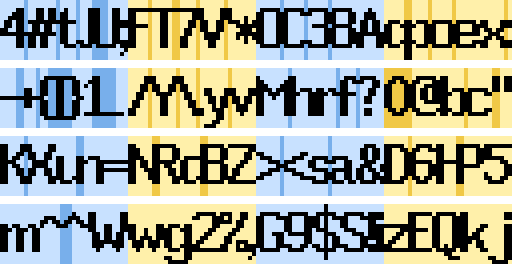
I especially liked the {][} sequence (near the start of the second row).
Any glyph contained within another glyph doesn't need to be packed separately.
There are a few examples, some surprising.
For example, l is the left side of U, and 0 is identical to () with the space between them removed.
The per-glyph metadata (not counting kerning) is conceptually four fields: the x position and width of the ink within the bitmap, the space on the left, and the advance. All this is tightly packed into a 32 bit integer.
JIT
In the generated JIT code, registers are assigned as follows:
- r0 points to the beginning of the row of the packed font bitmap
- r1 is the output buffer, a one-line 1 bit per pixel image buffer
- r2 is the accumulator for the output bitmap
- r3 holds the bits of one glyph, extracted from r4
- r4 holds 32 bits loaded from the glyph bitmap
In the simplest case, we add one glyph to the accumulator. The code looks like this:
    ldr r4, [r0, #(x_offset / 32 * 4)]
    ubfx r3, r4, #(x_offset % 32), #(width)
    orr r2, r3, lsl #(x % 32)
There's additional code to output a word when it's finished (stmia r1!, {r2}), and to handle cases when a glyph straddles a 32 bit boundary.
These are documented in text.sy.
But there is one trick I do want to mention here: the code as above has a result-use delay between the ldr and ubfx (unsigned bit field extract).
This is solved by shuffling the order of instructions somewhat: the last instruction for glyph i is reordered to follow the first instruction (ldr) of glyph i + 1, filling the delay slot, and reducing the cycle cost from 4 to 3.
Here's the inner loop of the code generator, focusing only on the case where the glyph doesn't straddle the accumulator.
For each glyph, several values are packed into the g variable, then unpacked below: the offset within the packed font bitmap (which further breaks down into a bit offset and a word offset), the width of the inked part, the left side bearing, and the advance.
    loop {
        g @r12 = *(glyphs + c * 4)
        // the next character, reading one past the end
        c = *text++
        width @r7 = g[20..26]
        bit_offset @r4 = g & 31
        if width == 0 goto blank
        // ubfx r3, r4, #offset % 32, #width
        ubfx_instr @r11 = *(ubfx_table + bit_offset * 4)
        // ldr r4, [r0, #offset / 32]; the font is narrower than 32 words,
        // so the offset fits, and strh leaves out what's above it.
        word_offset @r4 = g >> 5
        ldr @r4 = ldr_base + (word_offset << 6)
        ubfx_instr += width << 16
        *slot = ldr
        // left side bearing
        left @r4 = (g as i32)[16..20]
        *(code as *u32) = ubfx_instr
        // shift: where the glyph starts, relative to the word in r2. Branch is
        // also taken if negative.
        shift @r4 = pen + left
        room @r7 = 32 - width
        pen += g >> 26
        #(shift - room)
        if #hi goto off_word
        // the delay: orr r2, r2, r3, lsl #shift
        d @r12 = *(orr_table + shift * 4)
        *((code + 6) as *u32) = d
        slot = code + 4
        code += 10
        #(n -= 1)
        if #ne goto loop
    }
Here's the corresponding machine code, ARM assembly code, and cycle count analysis from the symbolasm analysis tool:
  134: f859 c028           1 ldr r12, [r9, r8, lsl #2]
  136: f811 8b01           1 ldrb r8, [r1], #1
  137: f3cc 5705           1 ubfx r7, r12, #20, #6
  138: f00c 041f           1 and r4, r12, #31
  139: b387              1/2 cbz r7, .Ljit_text.blank
  141: f855 b024           1 ldr r11, [r5, r4, lsl #2]
  144: ea4f 145c H         1 lsr r4, r12, #5
  145: eb0a 1484           1 add r4, r10, r4, lsl #6
  146: eb0b 4b07           1 add r11, r11, r7, lsl #16
  147: 801c                1 strh r4, [r3]
  149: f34c 4403           1 sbfx r4, r12, #16, #4
  150: f8c0 b000 H         1 str r11, [r0]
  153: 1934                1 adds r4, r6, r4
  154: f1c7 0720           1 rsb r7, r7, #32
  155: eb06 669c           1 add r6, r6, r12, lsr #26
  156: 42bc                1 cmp r4, r7
  157: d821        K     0/2 bhi .Ljit_text.off_word
  159: f85e c024           1 ldr r12, [lr, r4, lsl #2]
  160: f8c0 c006           1 str r12, [r0, #6]
  161: 1d03                1 adds r3, r0, #4
  162: 300a                1 adds r0, r0, #10
  163: 3a01                1 subs r2, r2, #1
  164: d1da        K     0/2 bne .Ljit_text_0_loop
   loop 134-164: 23 cycles per iteration
The K flags indicate a possible delay in branches because the condition isn't known until the cycle before the branch.
Here, 0/2 indicates 0 cycles if the branch is not taken, and 2 if it is.
Neither of these can be optimized.
The H flag indicates the instruction is 32 bits rather than 16 because of the use of "hi" registers (r8-r15).
These are available in the LSP as well.
Performance
The basic loop is 23 cycles per glyph for the JIT plus 3 cycles times height for the bitmap generation. There's an additional cost of about 20 cycles for JIT and 2 cycles times height per 32 bits of output width.
This is astonishingly fast. The textdemo in vic-2350 takes about 21k cycles for the JIT and 42k cycles to run the JIT code. That adds up to about 2.6% of the available throughput of a single core of the RP2350. Expanding to 565 is actually about 3x more expensive. So it's fair to say it's as optimized as it can get.
While this was designed for race-the-beam rendering, it would work just as well writing into a framebuffer, especially a one bit per pixel framebuffer. Just generate the code, run it for each scanline.
It's tempting to cache the JIT output, but saving RAM is more important. The JIT output is about a 10x expansion over the input string. And, from the numbers above, it's clear that the cost of running the JIT is minimal.
The name "just in time" is apt; in the implementation in vic-2350, the JIT compiler runs under 100µs before scanout of the video line.
I wasn't able to find a direct performance comparison to an existing RP2350 text renderer. Probably the closest is dvhstx by Michael Bell and forked by Adafruit. That also ends up spending approximately 2-2.5 cycles total per pixel, but is limited to a 14x24 grid and also uses an RGB 222 mode, so its output bandwidth is only half as much (and this is where the lion's share of the time goes).
Dot Product Kerning
Kerning is a very important refinement for text rendering, otherwise the spacing looks irregular. The general mechanism in OpenType fonts is quite complex. For this project, I wanted something simple and efficient, so dusted off an idea that was originally motivated by trying to do text layout on GPU.
Basically, each glyph has two bitvectors, one each for the left and right side.
To kern two glyphs, take the and of the right bitvector of the first glyph and the left bitvector of the second, then the popcount (number of 1 bits) of that, resulting in the number of pixels to kern.
That's actually just the dot product of the two vectors, bits interpreted as 0 and 1.
The kern tables require only two bytes per glyph, and kerning is super fast to evaluate.
Even so, kerning evaluation is done at display list build time, not racing the beam. When the kern is nonzero, a special negative space character is inserted into the string in the text display object.
For this font, I built the kerning table manually.
Each bit is a specific feature, for example bit 0 represents the top right of the first glyph projecting out, and a corresponding lack of ink in the top left of the next glyph.
So it is set on the right of T and Y, and also at the left of most lowercase letters and also A.
It's not hard to imagine a tool that might help automate this, perhaps distilling kerning information prepared in other ways.
I haven't done a real implementation yet, but I suspect this idea might scale to real fonts: instead of bits and an integer kerning amount, the vectors would store continuous values (reasonably quantized). An additional nonlinear step after the multiplication but before the sum may also help. Dot products are of course ridiculously efficient to compute on GPU, while doing index chasing through OpenType tables is not. But that exploration is for another day.
Kerning improves quality considerably:

AI disclosure
This work is a refinement of the text rendering in pico-dvi-rs, which was hand-written. My draft of the JIT core was hand-written in Rust, then I used Claude to translate it to symbolasm and refine and optimize it. This blog is hand-written.
The symbolasm compiler and analysis tool is heavily LLM assisted, though it too evolved from an initial hand-written version.
I did a microtypography experiment that was a pretty cool result, but decided not to include it, partially because it would have increased the fraction of LLM content.
Like most other people in the industry, I struggle with the balance between quality and the acceleration that LLMs provide. Claude is exceedingly good at the low level tasks of coding; it easily found an edge case in my draft of the JIT compiler. I find that when used judiciously, LLM can improve quality, and I strive for that.
Related work
I wasn't able to find much precedent for JIT specifically for text rendering. Of course, there is a massive literature on JIT in general. On-the-fly code generation for bitblt was done for the Blit around 1982. See Bitmap Graphics SIGGRAPH 84 for more. An interesting detail is that they claim about 2500 characters per second; the raw performance of this on RP2350 hardware is almost 3 orders of magnitude greater, just counting the output to 1bpp (which is how the Blit's framebuffer was configured).